


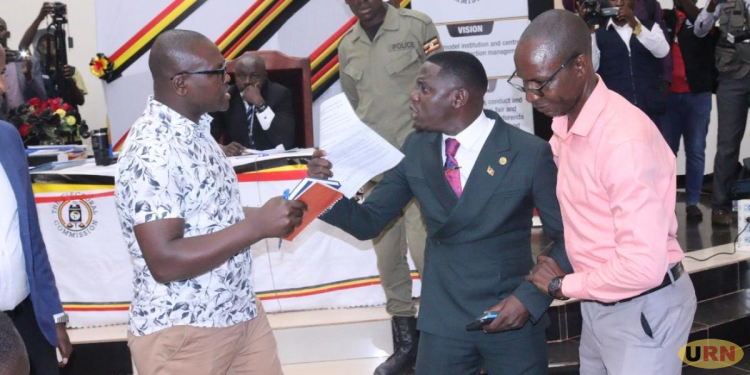
There was drama at Wakiso District headquarters on Thursday morning as independent candidates clashed over campaign symbols during nominations for the Kyadondo East parliamentary race.
The tension began when independent candidate Paul Magezi, who had earlier attempted to run for president before settling for the MP seat, complained of what he called unfair treatment by the returning officer.
Dressed in an army green suit, Magezi had arrived early, expecting to be the first independent candidate nominated. But when Khalid Ssimbwa, another independent, arrived later and was nominated ahead of him, Magezi stormed the returning officer’s table, demanding an explanation.
“Nomination of independents is first-come, first-served. I came here first,” Magezi shouted as plainclothes officers tried to restrain him. His protest drew attention from other candidates and supporters inside the crowded room.
Patience Jackie Nantege, another independent, joined the protest, saying her preferred symbol—a watch—was at risk.
“The reason I came early was to get the watch. The returning officer should be fair,” she said.
As the standoff intensified, security officers moved in. But the incumbent MP, Muwada Nkunyingi of the National Unity Platform (NUP), intervened.
“He is a candidate like us. You can’t drag him out. He should be heard,” he said, prompting the officers to withdraw. Magezi accused Ssimbwa of trying to “steal” his preferred symbol, a ball, which he said represented his passion for the youth.
The returning officer, who kept calm throughout the exchange, went on with the process and nominated Ssimbwa, who settled for a house symbol instead.
One of the supporters of Ssimbwa told our reporter that, indeed, they too wanted to take a ball since their candidate is a renowned supporter of youth talent and one of the benefactors of Kyandondo county club in the Buganda Masaza tournament, which is popular in the Buganda kingdom. Nantege later got her watch symbol.
But the ball, which Magezi had wanted, was taken by Tom Muwonge, the outgoing Kasangati LC III chairperson, now contesting for Parliament. The angry Magezi was later nominated after choosing a radio as his symbol.
Meaning Behind the Symbols
While party candidates use official logos, independents rely on symbols assigned by the Electoral Commission (EC).
These symbols often influence voter recognition, especially among illiterate voters. Cyprian Ogwang, the Head of Research and Planning at the Electoral Commission, noted that ideally, symbols are used in elections to facilitate voting by illiterate people, who cannot read candidates’ names on the ballot. “These are just symbols. We select them for the purpose of guiding the electorate on the polling day. They are easy to identify. But they are not based on any political sentiment. They must not be attached to culture or religion to avoid the possibility of some candidates misusing them,” Ogwang said. Peter Bogere, an elections expert at Uganda Project Implementation and Management Centre, also noted that good politicians will always find a way of crafting meaning around the given symbol.
“The shrewdness of a candidate doesn’t remove the primary objective of the designated symbol. There are several symbols that are becoming more popular compared to others as independent candidates have developed a perception to an extent that they also fight to be nominated first,” he said. He also pointed out that several candidates have a close relation to some political parties, pointing out the clock, which is associated with the People Power pressure groups.
Data and Trends
Data from the EC shows that in the 2021 elections, the clock was the most popular independent symbol with 344 candidates, followed by radio (223), chair (192), and ball (185). Less popular choices included tree (1) (this symbol has now been taken over by a political party), candle (3), and saucepan (60). None of the candidates chose a boat or a bunch of matooke.
In this election, the EC has provided 20 approved symbols for independents; these are drawn from everyday items as symbols designed to be easily recognizable and resonate with grassroots voters. These include a ball, banana, boat, book, borehole, candle, car, chair, clock, coffee, cup, house, jerrycan, kettle, megaphone, pot, radio, saucepan, table, and television.
The confrontation at Wakiso district headquarters highlighted how competition over these symbols can mirror the intensity of the political race itself.
For independent candidates like Magezi, the symbol is more than an image on the ballot; it represents identity, memory, and a strategy for visibility in a crowded field. Major political parties also rely on symbols to guide voters on the ballot.
The National Resistance Movement (NRM) uses the yellow bus, while the National Unity Platform (NUP) is identified by the umbrella, the People’s Front for Freedom uses a mobile phone, while the Forum for Democratic Change (FDC) uses the key, and the Democratic Party (DP) maintains the hoe.
Other party symbols include a light bulb for the Alliance for National Transformation (ANT), a peace sign for the Conservative Party (CP), and a tree for the Democratic Front (DF).
The Ecological Party of Uganda (EPU) uses a microphone, the National Peasants’ Party (NPP) uses a pen, and the People’s Progressive Party (PPP) uses a lantern. The Uganda Federal Alliance (UFA) is represented by a giraffe, while the Revolutionary People’s Party (RPP) uses two hands holding the map of Uganda.
Email:homelandnewspaper@gmail.com


