


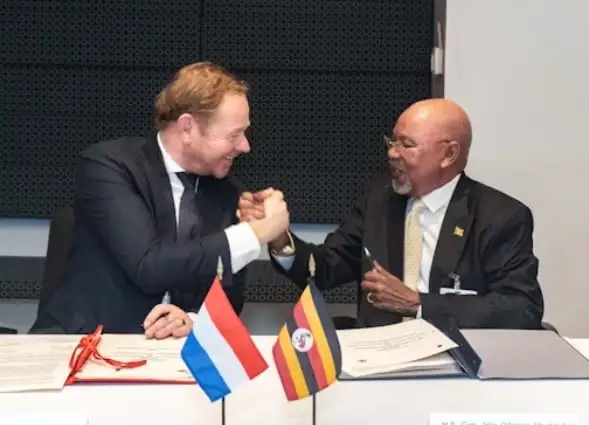
New York — In a bid to streamline the repatriation of failed asylum claimants, the Netherlands and Uganda have signed a letter of intent to establish a transit hub in Uganda for select rejected migrants, Dutch officials announced Thursday.
The agreement was formalized here on the sidelines of the United Nations General Assembly by Dutch Migration and Foreign Affairs Minister David van Weel and his Ugandan counterpart, Odongo Jeje Abubakhar. It marks a collaborative effort to address bottlenecks in returning individuals whose asylum claims have been denied but who cannot immediately or voluntarily repatriate to their home countries.
Under the arrangement, the hub will serve as a temporary waystation exclusively for asylum seekers originating from nations proximate to Uganda. These individuals, required to depart the Netherlands, would be housed briefly in Uganda before proceeding to their countries of origin. The Dutch government described the initiative as a small-scale pilot, limited to a restricted number of participants, though no specific timeline for implementation was disclosed.
“We are taking this step with Uganda to get migration under control,” van Weel said in a statement. “Obviously the human rights of people who return to their country of origin via Uganda will be safeguarded.”
The pact aligns with broader European Union strategies to manage migration flows. In March, the European Commission proposed permitting member states to create migrant processing centers in third countries for those denied asylum, a measure aimed at easing pressures on national systems.
This development comes amid fluctuating asylum arrivals in the Netherlands. In 2024, the country recorded 32,175 asylum applications, reflecting a 16 percent decrease from the previous year. Yet immigration remains a flashpoint: The current caretaker government collapsed in June following irreconcilable disputes over policy, paving the way for elections next month where migration is expected to dominate debates.
Following the signing, the two nations plan to refine the letter of intent’s terms. The Netherlands intends to engage closely with the EU and international organizations, including the International Organization for Migration (IOM) and the United Nations High Commissioner for Refugees (UNHCR), to ensure compliance with global standards.
Efforts to reach Uganda’s foreign affairs ministry for comment were unsuccessful as of press time.
The pilot represents a pragmatic, if unconventional, approach to a persistent challenge, potentially setting a precedent for bilateral returns in the region. As details emerge, stakeholders will monitor safeguards for vulnerable returnees and the hub’s operational viability.
Email:homelandnewspaper@gmail.com


