


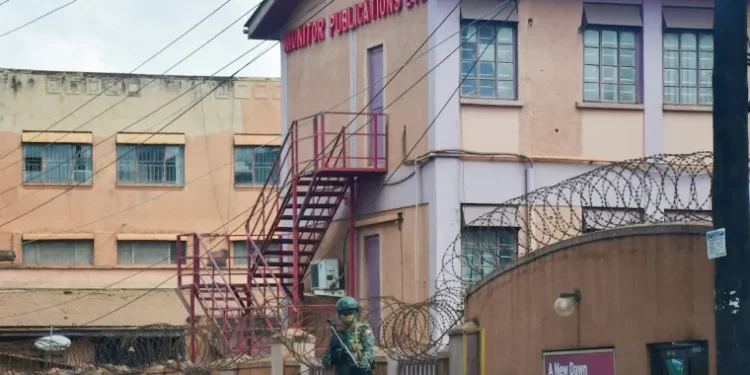
Nation Media Group is set to resume operations in Uganda after President Yoweri Museveni authorised the reopening of the media house, ending a shutdown that took the Daily Monitor, NTV Uganda and several other outlets off the market for a month.
The announcement was made on Tuesday in three separate statements issued by Taifa Group, the Tanzanian investment conglomerate that controls Nation Media Group, and by Nation Media Group Uganda. Taifa Group, through its subsidiary Taarifa Limited, is the majority shareholder in the Nairobi-headquartered media company, having acquired a controlling 54.08 percent stake in March 2026, ending the Aga Khan’s 66-year ownership of East Africa’s most influential media house.
Rostam Aziz, the chairman of Taifa Group, said in the statement that he had conveyed his gratitude to Museveni for authorising the resumption, and to General Muhoozi Kainerugaba, Chief of Defence Forces of the Uganda People’s Defence Forces, for what he described as support throughout the engagement that led to the outcome. Aziz said the group remained committed to Uganda’s socio-economic development through responsible investment and long-term partnerships, and that it fully supported the media company’s stated commitment to fair, balanced and independent journalism.
Nation Media Group chairman Joe Muganda said the group would focus on rebuilding its presence, reconnecting with audiences and strengthening its contribution to Uganda’s media sector, drawing on its operations across Kenya, Uganda, Tanzania and Rwanda. In a separate statement signed by Muganda, Nation Media Group Uganda said its services across television, print, radio and digital would be restored progressively as it completed operational arrangements, and thanked audiences, clients and partners for their patience during the closure.
The reopening brings to a close one of the most serious confrontations between the Ugandan state and the independent press in recent years. Security forces moved on Nation Media Group’s premises in the early hours of 28 June, sealing off its headquarters on 8th Street in the Namuwongo industrial area and its broadcast centre at the Kampala Serena International Conference Centre, and rendering the facilities inaccessible after electricity was disconnected. The affected outlets included NTV Uganda, the Daily Monitor, Spark TV, 93.3 KFM, 90.4 Dembe FM, Ennyanda and Nation Courier, together employing more than 500 people.
The operation followed a series of posts by Kainerugaba on his personal X account. “NTV and Monitor are being shut down from today,” he wrote at 1:07 a.m., adding in a later post that he did not believe in a free press and that it should be “guided by cadres of the revolution.” The company said at the time that no court order or regulatory instrument had been produced to justify the closure.
The government’s first formal explanation came two days later, when ICT and National Guidance Minister Justine Lumumba said the disruption formed part of a security-led inquiry instituted by Museveni and involving the UPDF, the Criminal Investigations Directorate and other security agencies. Lumumba did not disclose the subject of the inquiry.
Museveni entered the standoff publicly on 18 July, when he received Aziz at State House Entebbe, describing him as chairman of the Taifa Group and marking the strongest sign that the country’s top leadership was directly involved in resolving the shutdown.
The closure had drawn condemnation from press freedom and rights bodies. Amnesty International said at least six outlets had been shut, with its East and Southern Africa director Tigere Chagutah accusing the president’s son of an “unjust campaign of harassment and intimidation of independent media,” while a senior US lawmaker urged Washington to review its security relationship with Uganda. The Committee to Protect Journalists had called for the withdrawal of security forces from the company’s premises.
The dispute is the latest in a long history of tensions between the state and Nation Media Group Uganda, whose outlets were previously targeted in a 10-day police raid on the Daily Monitor in 2013 and a brief suspension of NTV Uganda in 2007.


