


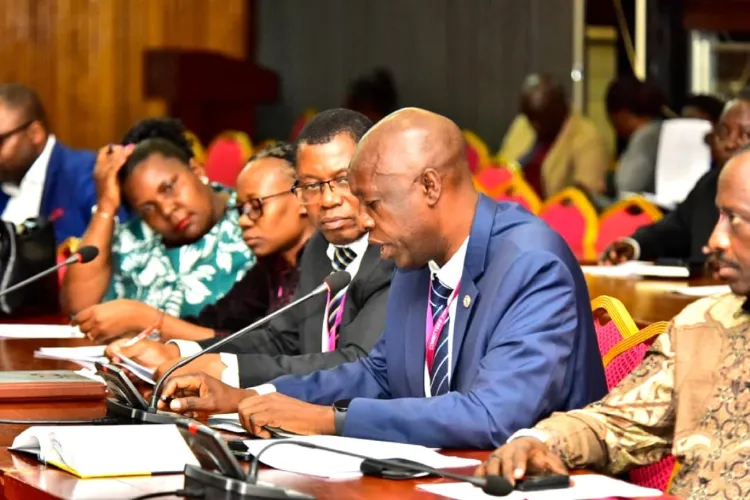
KAMPALA, Uganda — The Institute of Certified Public Accountants of Uganda has recommended that Parliament delete clauses in the proposed Income Tax (Amendment) Bill 2026 that would tax income from the disposal of non-business assets and introduce a 6% withholding tax on payments made when purchasing such assets.
Presenting the institute’s official comments on the tax amendment bills for the 2026/2027 financial year before the Committee on Finance, Planning and Economic Development chaired by Hon. Amos Kankunda on Wednesday, Silajji Kanyesigye of ICPAU argued the measures would unfairly burden ordinary citizens and discourage asset mobility.
“We propose that the clauses be deleted and the status quo be maintained,” Kanyesigye told the committee. “The proposed amendments will likely increase the financial burden on taxpayers associated with the disposal of non-business assets.”
He added the proposed amendment is anti-investment and likely to discourage asset mobility.
“Non-business assets are not used in the generation of income and therefore their disposal has no profit motive. Non-business assets are disposed of for personal reasons, such as settling personal bills like medical bills or the need to relocate if it is a property or building. This should not constitute a tax base,” he said.
On the planned excise duty of 300 shillings per kilogram on cane or beet sugar and chemically pure sucrose in solid form, he urged lawmakers either to drop the clause entirely or to introduce the tax gradually.
“We propose that the clause be dropped and the government consider a phased increase in the excise duty on sugar of 300 shillings per kilo over at least three years,” he said.
He noted sugar remains vital for micro and small-scale industries involved in food and beverages, warning a sharp increase could encourage smuggling from neighboring countries, undermine local manufacturers and make vulnerable groups such as women and the urban poor even more vulnerable.
Turning to the entertainment sector, Kanyesigye welcomed the introduction of withholding tax on payments to public entertainers but called for a higher rate to boost revenue and bring the growing creative industry into the formal economy.
“We welcome the proposal and further propose that the withholding tax rate applicable should be increased to 15%. This will not only aid in revenue generation but also help in formalizing taxation within the entertainment sector,” he said.
The ICPAU presentation also highlighted weaknesses in Uganda’s personal income tax structure. Kanyesigye described the proposed increase in the monthly Pay As You Earn threshold as a modest improvement but still inadequate after 14 years of inflation. He said Uganda’s thresholds and rates compare unfavorably with those in Kenya, Tanzania and Rwanda, arguing high effective rates at relatively low income levels make the country less competitive for regional investment and talent. He urged greater harmonization with East African neighbors to support job creation and economic growth.
On fuel, Kanyesigye opposed the proposed 200-shilling per liter increase on gasoline and gas oil, saying demand for these products is inelastic and any additional tax would ultimately be passed on to consumers and businesses already struggling with high production costs. He suggested either maintaining current rates or limiting future increases strictly to inflation levels.
The accountants further recommended extending the period for carrying forward business losses from seven to 10 years and lowering the associated minimum tax to 0.1% applied to gross profit rather than gross income, arguing many capital-intensive investments require longer payback periods.
Kanyesigye also cautioned against raising stamp duty on land transfers from 1.5% to 3%, warning the higher rate would make it harder for poor families, including orphans inheriting family land, to secure ownership. On plastics, the institute welcomed the environmental tax but called for consistency by reinstating duties on certain raw materials to support recycling efforts.
Throughout the submission, Kanyesigye balanced support for several government initiatives aimed at expanding the tax base and improving compliance, such as raising the VAT registration threshold and introducing waivers for very old tax arrears, with firm opposition to measures likely to raise living costs, discourage investment or penalize personal financial decisions.


