


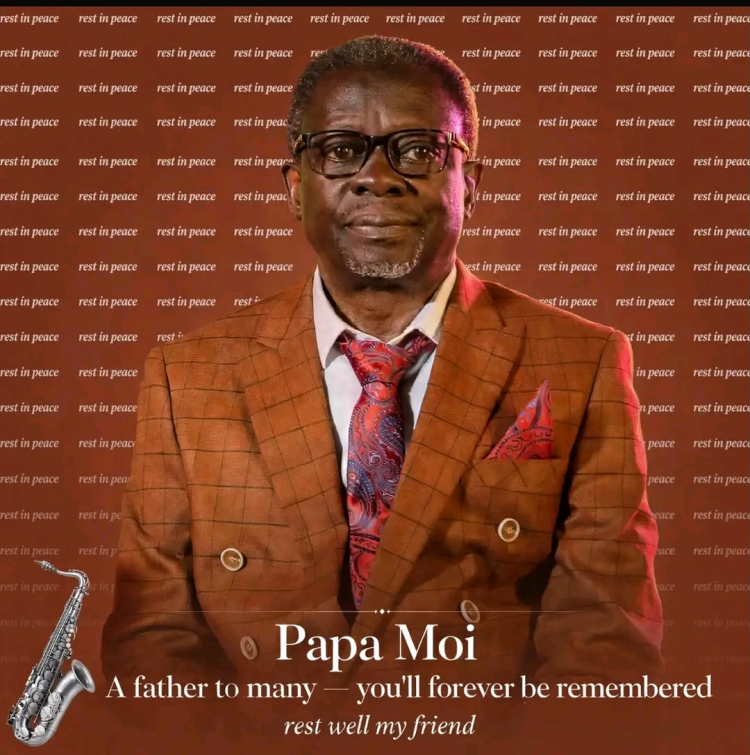
Uganda’s music industry has lost one of its most enduring figures, Moses Matovu, the veteran musician, saxophonist, singer, composer and longtime leader of Afrigo Band, whose career stretched across nearly six decades.
Matovu died on Thursday, September 24, 2026, at Kibuli Hospital after he was reportedly attacked by unidentified assailants in the Kibuli area of Kampala.
Police said Matovu was attacked early Thursday at Kibuli Market Zone B in Makindye Division and later succumbed to his injuries at the hospital. Preliminary information indicated that he had been on his way to a mosque for morning prayers.
Police said investigations were underway to establish the circumstances surrounding the attack and identify those responsible.
He was 77.
But for many Ugandans, Matovu’s death is more than the passing of an individual musician.
It marks the end of an era.
For generations that grew up listening to live bands, dancing in Kampala’s clubs and social halls, or simply enjoying Ugandan music at home, Matovu was a familiar name and face.
He was the man behind the saxophone, the voice, the composer, the bandleader and, perhaps most importantly, the custodian of a musical institution that survived when many others disappeared.
From a church choir to the national stage
Born on June 19, 1949, in Kawempe, Kampala, to Abdallah Bukenya and Solome Nakitto, Matovu’s relationship with music began when he was still a child.
He sang in the Namirembe Cathedral Choir at a young age, an experience that introduced him to music and helped shape the career that would eventually make him one of Uganda’s most recognised musicians.
He attended Namirembe Primary School and later pursued his secondary education before his passion for music and football increasingly took over his life.
Football was, for a time, another serious possibility.
Matovu played for several clubs, including Nakivubo Boys, Lint Marketing Board, Police, Express and Fiat. He eventually abandoned competitive football to concentrate fully on music in the early 1970s.
By then, the stage was already calling.
In 1967, he began his professional music career as a vocalist with the Thunderbirds Band. He later joined the Police Band and then the Cranes Band, where he developed further as a vocalist and instrumentalist.
His experience with the Police Band also helped him develop his skills with instruments including the saxophone and clarinet.
Then came Afrigo.
The birth of Afrigo
When the Cranes Band broke apart in the mid-1970s, Matovu and fellow musicians went on to establish Afrigo Band.
On August 31, 1975, Matovu, Tony Ssenkebejje, Jef Sewava, Charles Ssekyanzi and Jessy Gitta are among those credited with forming the band in Kampala.
What followed became one of the most remarkable stories in Uganda’s entertainment history.
Afrigo did not simply become another band.
It became an institution.
The group blended Ugandan rhythms with Congolese rumba, jazz and other influences, creating a distinctive sound that largely used Luganda while also incorporating other local languages and Kiswahili.
For more than five decades, Afrigo continued to perform while countless other bands came and went.
And throughout much of that journey, Matovu remained at its centre.
He was not simply the man carrying a saxophone on stage.
He was a singer, songwriter, composer, arranger, flautist, saxophonist and bandleader whose understanding of music helped Afrigo evolve without abandoning its identity.
The songs that became part of Uganda
Matovu’s contribution cannot be measured only by the number of years he spent on stage.
He helped create music that became part of Uganda’s cultural memory.
Among the songs associated with Matovu and Afrigo are “Nantongo,” “Silina Anantwaala,” “Teri Mubi,” “Emiziro,” “Ekkizi Ekadde,” “Sofia,” “Genda Osome” and “Afrigo Batuuse.”
Afrigo’s catalogue grew to more than 20 albums, with works including Afrigo Batuuse, Jim, Genda Osome, Vincent, Mp’Eddembe, Julie, Afrigo Batuuse II, Omutanda Gyali and Teri Mubi.
The 2019 album Teri Mubi demonstrated that Matovu was not interested merely in preserving the past.
He continued revisiting old compositions, rearranging them and introducing them to newer audiences.
One example was Emiziro, a song he had originally recorded with Cranes Band in 1970 before later revisiting it with Afrigo.
That ability to connect generations was one of his defining qualities.
A teacher as much as a performer
Perhaps Matovu’s greatest contribution was not any single song.
It was the people.
Afrigo became a training ground for generations of Ugandan musicians. Several respected artistes passed through its ranks, learning the discipline of live performance and the demands of sustaining a professional band.
Matovu understood that for Afrigo to survive, it had to be bigger than the people who founded it.
That philosophy helped the band remain relevant across changing generations, technologies and musical tastes.
From the era of live club performances and vinyl records to cassettes, CDs, digital music and streaming, Afrigo remained visible.
Matovu remained there too.
Recognition came, eventually
The music industry did not completely overlook Matovu’s contribution.
In 2021, the Janzi Awards Academy selected him for its inaugural Janzi Lifetime Achievement Award, recognising his decades-long contribution to Uganda’s arts, creative and performing industry.
He also received lifetime recognition through the HiPipo Music Awards.
Beyond performing, Matovu served in leadership roles within Uganda’s music industry, including as chairman of the Uganda Musicians Union and chairman of the Uganda Performing Rights Society, now associated with the Uganda Musicians Association.
There was also a later campaign for Makerere University to honour him with an honorary doctorate for his contribution to Uganda’s music and creative industry.
That recognition, however, never came while he was alive.
Fifty years of Afrigo
In 2025, Afrigo reached a historic milestone — 50 years since its formation.
Matovu was still performing.
At 76, he stood alongside younger musicians as the band celebrated five decades of music, a remarkable demonstration of the longevity of both the man and the institution he helped build.
Few Ugandan musicians can claim such continuity.
Governments changed.
Music formats changed.
Nightclubs changed.
Audiences changed.
New genres emerged.
Yet Afrigo remained.
And Matovu remained the familiar figure at its heart.
A complicated legacy, but an undeniable one
Matovu’s life was inseparable from music.
He once described music as his first job and said that he spent his life listening to music, thinking about music and admiring good musicians.
That devotion explains why his career survived for so long.
He did not merely perform music
He lived inside it.
His saxophone became part of the soundscape of Kampala, while his leadership helped transform Afrigo from a band founded in the 1970s into one of Uganda’s longest-running musical institutions.
His death therefore leaves a gap that will not easily be filled.
The young musician can inherit a stage.
A band can recruit another saxophonist.
A singer can perform the old songs.
But the lived history carried by Moses Matovu — from the church choir, through football, Thunderbirds, Police Band and Cranes Band, to the creation and five-decade survival of Afrigo — cannot simply be replaced.
The music remains
Moses Matovu is gone.
But his music is not.
The saxophone may have fallen silent, but the songs remain.
The generations he mentored remain.
Afrigo remains.
And whenever the familiar sounds of “Nantongo,” “Jim,” “Obangaina,” “Amazzi Genyama,” “Rose Guma,” “Afrigo Batuuse” or the many other songs associated with his career fill a room, a club, a radio station or a family gathering, there will be a reminder of the man who spent almost 60 years giving Uganda music.
Moses Matovu’s story was ultimately not just about fame.
It was about endurance.
It was about preserving a sound.
It was about creating something that could outlive its creator.
For nearly six decades, he gave Uganda his music.
Now Uganda is left with the music — and the memory of the man behind it.
Moses Matovu, 1949–2026.


